|
|
Module Three |
|
|
As you
can see from the “table of contents” page, there are five modules, each
lasting for three weeks. The dates for
the module are delineated on that previous page. This is
your third module and we will pass the halfway point
of the semester at its midpoint. While
you read about the Antebellum Period in the first part of the module, those
living then did not see it as such. To them, it was life
and the Union would find a way to persist, as it
always had (the theme of one of the essay questions). While Professor Ayers
has shaped our thinking more holistically when thinking of the causes of the
war, the centrality of slavery is inescapable (the other essay question).
Once war came, each side hardened their positions: breaking away to refocus
the country versus maintaining the Union. As central as war was, whites did not
see slavery having anything to do with the war. But as the historian Barbara
Fields will explain to you, slaves knew what the war was about. |
||
|
Special
assignment: this module is going to have a “mini-module”
in it. You should plan on completing
that work in the first week (there are two parts to do, see
announcement). For the
rest of the module, you will have the entire three-week period. Again, a caution: do not put your work off
until the last minute (very easy to do, BUT NOT in your best interests).
You will
be assessed on the quality of your writing and the variety of assigned
sources you use. |
||
|
Course
textbook readings for Module Three: From
Gallagher/Waugh, The American War, read through chapter three. From
Fetter-Vorm/Kelman. Battle
Lines, chapters one through four** Henry
David Thoreau, “Slavery
in Massachusetts” **Ari Kelman is an award-winning historian at the University of
California – Davis. He wanted to write a history of the Civil War for a
general audience. Faced with word limitations that were too constraining, he
came upon the idea of a graphic novel. I think it works quite well (full disclosure:
I have been reading comic books for fifty-plus years and graphic novels for
forty-plus years. Couldn’t resist, especially as it is well done). |
||
|
Videos
for this first module: -From the
Prudence Crandall Museum, “To All on Equal
Terms” -From
the Federal Judicial Center, “Amistad: The Federal
Courts and the Challenge to Slavery” (did you spot the connection with
Prudence Crandall?) -From The
Biography of America, watch “Slavery”
and “The
Coming of the Civil War” -From The
Civil War: A Film by Ken Burns, “The
Cause” -From
C-SPAN, Fort
Sumter -From
Discerning History, Manassas -First
Battle of Bull Run (these have a short video at the top and a narrative
below) |
||
|
Below
are websites that have content connected to this module. They should be used as part of your
discussion posts and essays. Use them
to further your own learning or as a starting point for a possible research
topic. -Abraham
Lincoln, “A
House Divided” speech -Changes
in transportation,
linking a continent -On slavery
(at bottom of page, click “Next” three more times) -Using
maps to illustrate the impact of slavery
in the Southeast (seventh one may not work) -Political
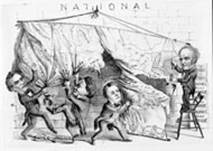
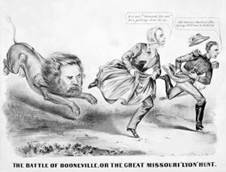
cartoons were important editorial tools for newspapers. They addressed
elections (click left cartoon in title bar) and battles (click right cartoon) -Presidential
election
of 1860 -This
addresses the “double
name” confusion you may encounter -This essay may help you understand some of the
terminology used in the videos and texts -Connecticut-born
Nathaniel Lyon
was instrumental at the war’s outset |
||
|
This
module’s essay, you choose one of the two below: A.
What to do about slavery was both a moral and economic question during the
antebellum period. Analyze the debate
over slavery and emancipation that took place during this period being sure
to explain what role it played in the first year of the war. B.
Americans believed themselves to be great compromisers, trusting in Union to
make everything right in the end.
Secession, however, brought that to an end. Why did compromise fail? You will want to use specific events and
political conflicts in answering this question. |
||